Articles by archivist

You are currently browsing archivist’s articles.

Our Ability is Ever from God, Not from Ourselves.

The apostle Paul in 2 Corinthians 2:14 – 3:5 (read please) spoke for every Christian when he acknowledged that, regardless of the effect of the gospel on people’s hearts, we in spreading that good news, are “a sweet fragrance to God.” He goes on to spell out that our spiritual aroma is a “smell of doom” to those who are lost, but a “vital fragrance, living and fresh” to those who are found in Christ. And then, in the latter part of verse 16 of 2 Corinthians 2, he asks the question which all soul-winners have asked of themselves, “And who is qualified, fit and sufficient, for these things? (Who is able for such a ministry? We?” (Amplified Bible)

brainerd02David Brainerd, missionary to the Indians in the middle part of the seventeen hundreds, asked the same question on June 23, 1743 in his diary. Listen to his words:

“I scarce ever felt myself so unfit to exist as now: saw I was not worthy of a place among the Indians, where I am going, if God permit. Thought I should be ashamed to look them in the face, and much more to have my respect shown me there. Indeed I felt myself banished from the earth, as if all places were too good for such a wretch. I thought I should be ashamed to go among the very savages of Africa. I appeared to myself a creature fit for nothing, neither heaven nor earth. None know but those who feel it, what the soul endures that is sensibly shut out from the presence of God. Alas! It is more bitter than death.”

This Presbyterian missionary was feeling what the apostle Paul was feeling as to his inadequacy of being a instrument of the gospel. Thankfully, he continued on his mission, even as Paul did, recognizing that “our power and ability and sufficiency are from God.” (Amplified)

Words to Live By: “It is God who has qualified us, making us to be fit and worthy and sufficient. . . .” Second Corinthians 3:5 (Amplified Version) Let us each one go forth in service to Christ in the knowledge of that truth.

Tags: , , ,

Birth of Francis Landey Patton

pattonFLBorn in Warwick, Bermuda on January 22, 1843 to George John Patton and his wife, Mary A. Steele Patton, Francis L. Patton never became an American citizen, though most of his adult years were spent in the United States.

Nevin’s Presbyterian Encyclopedia indicates that he received his education at the University College in Toronto, followed by preparation for the ministry at both Knox College, Toronto and Princeton Theological Seminary in New Jersey, graduating there in 1865. Rev. Patton was ordained by the Presbytery of New York on June 1st, 1865 and installed as pastor of the 84th Street Presbyterian Church, and then served two other Presbyterian churches in the New York City area before moving to Chicago in 1873 to pastor the Jefferson Park Presbyterian Church. Dr. Patton also served concurrently as editor of The Interior, 1873-76 and as professor at what is now McCormick Seminary, 1871-1881. Capping his ministry in Chicago, he was honored to serve as Moderator of the General Assembly of the Presbyterian Church, U.S.A. in 1878.

During those busy years, Dr. Patton was engaged as the prosecutor in the heresy trial of the Rev. David Swing, in 1874. The national attention given to this trial may in part have led to the call issued by Princeton Theological Seminary, where Dr. Patton then served as professor of apologetics from 1881 until his retirement in 1913.

In 1932, Edith Bane, a Pittsburgh native, paid a visit to Dr. Patton at his home in Bermuda. She wrote of that visit :

patton_carberry“When I met him last August, he was in his 90th year, yet seemingly in good health, unbowed in stature and alert of mind. Although handicapped by loss of eyesight, years had not dimmed his spirit, his well-known keen sense of humor, or his interest in old friends, his beloved Princeton and the work of the Presbyterian Church. He and Mrs. Patton were living with their son and daughter, Mr. and Mrs. George S[tevenson] Patton, at “Carberry Hill,” the stately old mansion in Warwick, Bermuda, where Dr. Patton was born and where he has lived since his retirement . . .

“. . . he was presented by his parents in Christ Church, Bermuda. It is significant that this child destined to be the powerful supporter and valiant defender of the faith of his fathers, should have been dedicated to the Lord in this historic church—the oldest Presbyterian church in the British overseas empire. Who can doubt that this great life work was but an answer to the prayers offered by his godly parents on that day? . . .

patton01” . . . In 1913, because of advancing years and failing eyesight, he resigned from the seminary and returned to his Bermuda home. It was surely the hand of Providence that led him back to these quiet coral gardens of the Atlantic to spend the evening of his life. As he looked out upon those cedar-covered hills and walked along the shores of the undescribable opalescent sea, he must often have repeated, with a thankful heart: “He maketh me to lie down in green pastures; he leadeth me beside the still waters . . . ”

“. . . November 25, 1932, after a short illness, he died, and the Presbyterian Church throughout the world faltered at the loss of its beloved patriarch.

Words to Live By:  Truly our lives are in the Lord’s hands. He guides and equips us to proclaim His glory in the good news of salvation in Christ Jesus alone. Our lives may have their disappointments, frustrations and failures, but God’s love for each of His children is unshakable and His plan is sure. What may seem an unprofitable failure will be used of the Lord as He refines us for greater service. “The steps of a good man are ordered by the LORD: and he delighteth in his way.” (Psalm 37:23, KJV).

Tags: , , ,

Back in the early years of the Internet, the Rev. David W. Hall was pastor of Covenant Presbyterian Church, in Oak Ridge, Tennessee. David had a number of scientists and engineers in the congregation and so was able to make good advantage of the Web in those early days. Under the title of Premise, he initiated a web-based magazine. The content of that magazine is no longer online, but it is preserved at the PCA Historical Center. From one issue of Premise, we are reproducing here an article on Francis Makemie, “the father of American Presbyterianism.”:—

Francis Makemie and Freedom of Speech

Rev. Francis Makemie on Trial before Lord CornburyOne illustration of how religion and politics were interwoven, especially the religion and politics of strongly Scottish Calvinist sentiment, can be seen from the experience of Ulster Presbyterian missionary Francis Makemie (b. 1658). Makemie had been reared on tales of the Scottish rebellion that adopted the Solemn League and Covenant, and he was educated at the University of Glasgow one generation after Samuel Rutherford. Commissioned by the Presbytery of Laggan, a fiercely Calvinistic stronghold, the first Presbyterian minister on the North American continent landed on the eastern shore of Chesapeake Bay in 1683. Over time, he earned a reputation as a threat to the Anglicans in the area, and he was reported to the Bishop of London (who never had authority over Makemie) to be a pillar of the Presbyterian sect. His work was commended by Puritan giant Cotton Mather, and his correspondence with Increase Mather indicates considerable commonality of purpose among early American Calvinists. Cotton Mather would later recommend a Catechism composed by Makemie for his New England churches.

Makemie organized at least seven Presbyterian churches committed to the Westminster Confession of Faith and Scottish ecclesiastical order between 1683-1705. In between the organizing of churches along Scottish models—the Scottish League and Covenant seemed to be blossoming in America, perhaps more than in its native Scotland—Makemie served as a pastor in Barbados from 1696 to 1698. He also sheltered persecuted Irish Calvinist ministers from 1683-1688. Following the Glorious Revolution in 1688 the need for shelter in America diminished, and some of these religious refugees returned to Ireland and Scotland. Makemie, however, remained in America, found a wife, and continued organizing Presbyterian congregations throughout Maryland, New Jersey, and Pennsylvania. In a 1699 letter, Makemie still spoke reverentially of Geneva as a Calvinist center.

Ministers from the Church of England protested Makemie’s church planting, caricaturing his ministry as subversive and nonconformist. Eventually the Sheriff of Long Island at the behest of the British Governor of New York, Lord Cornbury arrested Makemie and another Presbyterian colleague, John Hampton, for preaching without a license by. On January 21, 1707, the warrant for their arrest charged them with spreading “their Pernicious Doctrine and Principles” in Long Island without “having obtained My License for so doing, which is directly contrary to the known laws of England.”

Cornbury’s oppressiveness was well known from several earlier cases, and Makemie realized that if freedom of religion were not granted in one colony, America would never have the kind of free expression needed. He may have viewed New York as a mission for religious freedom; en route to Boston from New Jersey, he could have simply avoided Cornbury’s territory. In what would become one of the earliest tests of freedom of speech in America, this Irish Calvinist was indicted by an Anglican authority (also exposing an early establishment of religion in New York) and held for two days prior to trial.

MakemieStatueMakemie appeared before Cornbury (who called the missionary “a Disturber of Governments”) in the council chamber at Fort Anne, New York, on the afternoon of January 23, 1707. Lord Cornbury (Edward Hyde) charged: “How dare you take upon you to preach in my Government without my License”! Makemie answered that Parliament had granted liberty to preach in 1688 under William and Mary. Cornbury contended that such laws did not extend to the American colonies. Makemie answered that the act of Parliament was not restricted to Great Britain alone, but applied to all her territories; Makemie also produced certificates from courts in Virginia and Maryland that had already recognized his work. When Cornbury argued that ‘all politics is local,’ including rights and penalties, Makemie reminded him and his attorneys that the Act of Toleration was applicable in Scotland, Wales, Barbados, Virginia, and Maryland, and that without express restriction it was also applicable in all “her Majesties Dominions”—unless, of course, New York was not considered under her dominion.

Notwithstanding, Cornbury did not want Makemie or other “Strolling” preachers in his territory. Makemie further argued that strolling Quakers were permitted religious liberty in the colonies, which brought Cornbury’s equal-opportunity-oppressor rejoinder: “I have troubled some of them, and will trouble them more.” When Cornbury revived his charge that Makemie was spreading “pernicious doctrines,” the Ulster missionary answered that the Westminster Confession of Faith was very similar to the Thirty-Nine Articles of the Church of England and challenged “all the Clergy of York to show us any false or pernicious doctrines therein.” Makemie even stated his willingness to subscribe to the Thirty-Nine Articles should that satisfy the Governor.

Earlier Makemie had applied to the Governor to preach in a Dutch Reformed Church in New York and had been denied permission. His speaking in a private home gave rise to the charge of preaching unlawfully. Cornbury reiterated that Makemie was preaching without license, charging him to post bond for his good behavior and to promise not to preach again without licence. Although he disputed any charges against his behavior, Makemie consented to post bond for his good behavior (knowing there were no provable charges), but he refused to post bond to keep silence, promising in Lutheresque words that “if invited and desired by any people, we neither can, nor dare” refuse to preach. Like Luther, Makemie could do no other.

Cornbury then ruled, “Then you must go to Gaol?” Makemie’s answer is instructive.

[I]t will be unaccountable to England, to hear, that Jews, who openly blaspheme the Name of the Lord Jesus Christ, and disown the whole Christian religion; Quakers who disown the Fundamental Doctrines of the Church of England and both Sacraments; Lutherans, and all others, are tolerated in Your Lordships Government; and only we, who have complied, and who are still ready to comply with the Act of Toleration, and are nearest to, and likest the Church of England of any Dissenters, should be hindered, and that only the Government of New-York and the Jersies. This will appear strange indeed.

Cornbury responded that Makemie would have to blame the Queen, to which the defendant answered that he did not blame her Majesty, for she did not limit his speech or free religious expression. At last, Lord Cornbury relented and signed a release for the prisoners, charging both Makemie and John Hampton, however, with court costs. Before leaving, Makemie requested that the Governor’s attorneys produce the law that delimited the Act of Toleration from application in any particular American colony. The attorney for Cornbury produced a copy, and when Makemie offered to pay the attorney for a copy of the specific paragraph that limited the Act of Parliament, the attorney declined and the proceedings came to a close.

In a parting shot, Lord Cornbury confessed to Makemie, “You Sir, Know Law.” Makemie was later acquitted, and free speech and free expression of religion, apart from government’s approval, took a stride forward in the New World. Makemie pioneered religious liberty at great risk, and all who enjoy religious freedom remain in debt to this Scots-Irish son of Calvin.

Upon hearing of Makemie’s eventual (though delayed) release, the esteemed Cotton Mather wrote to his colleague the Rev. Samuel Penhallow on July 8, 1707:

“That Brave man, Mr. Makemie, has after a famous trial at N. York, bravely triumphed over the Act of Uniformity, and the other poenal laws for the Church of England, without permitting the matter to come so far as to pleading the act of toleration. He has compelled an acknowledgement that lawes aforesaid, are but local ones and have nothing to do with the Plantations. The Non-Conformist Religion and interest is . . . likely to prevail mightily in the Southern Colonies. I send you two or three of Mr. Makemie’s books to be dispersed. . . .”

In another blow for religious freedom, the next year a Somerset County, Maryland, court approved the certification for a Protestant Dissenter church to be established. By a narrow 3-2 vote of the court, Makemie secured liberty for Presbyterian churches under “an act of parliament made the first year of King William and Queen Mary establishing the liberty of Protestant Dissenters.”

Makemie was also instrumental in laying the groundwork for an Irish priest, William Tennent, to immigrate to America. Tennent would later establish the “Log College,” and one of its students, the Rev. Samuel Finley, started the West Nottingham Academy in 1741. These schools, much like Calvin’s Academy in Geneva, became the proving grounds of the American republic. From this one Academy came founders of four colleges, two U. S. representatives, one senator, two members of the Continental Congress, and two signatories of the Declaration of Independence (Benjamin Rush and Richard Stockton). Samuel Finley went on to become president of the College of New Jersey (later Princeton) in 1761.

This developing American Calvinism, far from the modern caricature as a narrow or severe sect, was a boost to personal freedom and civil discourse in its heyday. The first American Presbyterian pastor helped entrench the right to free expression and free worship by appealing to the principles of the Glorious Revolution. A tidal wave of Calvinistic thinking came to America through immigrants like Makemie and continued to radiate outward.

Tags: , , , ,

Presbyterians in Southwest Virginia Declare Independence from England

In September of 1774, the first Continental Congress met in Philadelphia to protest some British laws which were deemed to be injurious to the people of the American colonies. One of them had been to deem all territory north of the Ohio River to Quebec, a Roman Catholic province. With that protestation, these early risings of independence sent petitions to their British rulers, urging at the same time that the people of the colonies take action by boycotting certain British goods. All over the colonies, committees came together to discuss their collective responses to this call.

On January 20, 1775, a group of people representing southwest Virginia, met in the town of Abington, Virginia. A committee was formed, made up primarily of Presbyterians in two churches pastored by Charles Cummings. Their names deserve to be mentioned, as they were the key Presbyterian laymen of that area. They were, along with their rank, Colonel William Christian, Colonel William Preston, Captain Stephen Trigg, Major Arthur Campbell, John Montgomery, James McGavock. William Campbell, Thomas Madison, Daniel Smith, William Russell, Evan Shelby, and William Edmundson.

After discussion together, they as a body sent an address to the Second Continental Congress, soon to meet, which included the following words:

“We by no means desire to shake off our duty or allegiance to our lawful sovereign, but on the contrary, shall ever glory in being the loyal subjects of a Protestant prince descended from such illustrious progenitors, so long as we can enjoy the free exercise of our religion as Protestants and our liberties and properties as British subjects. But if no pacific measures shall be proposed or adopted by Great Britain, and our enemies will attempt to dragoon us out of those inestimable privileges which we are entitled to as subjects, and to reduce us to slavery, we declare that we are deliberately and resolutely determined never to surrender them to any power upon earth, but at the expense of our lives.”

Here was no wild-eyed statement of revolution, but rather a carefully formulated statement of subjection to lawful authority, as long as the latter did not seek to take away the rights and privileges of its citizens, and thereby make them little more than slaves. It was thought that the wording of this declaration was essentially that of Presbyterian pastor Charles Cummings.

They were sent to the Second Continental Congress as the spirit of southwest Virginia with regards to the important issues of liberty and justice for all.

Words to Live By: “Without counsel plans fail, but with many advisers they succeed.” Proverbs 15:22 (ESV);

“For by wise guidance you can wage your war, and in abundance of counselors there is victory.” Proverbs 24:6 (ESV)

Tags: , , ,

Man Knows Not His Time.

“So teach us to number our days, that we may apply our hearts unto wisdom.”—(Psalm 90:12, KJV)

It was on this day, January 19th, in 1812, that the Rev. Dr. Samuel Miller delivered a sermon “at the request of a number of young gentlemen of the city of New-York who had assembled to express their condolence with the inhabitants of Richmond, on the late mournful dispensation of Providence in that city.” A terrible event, the tragedy caught the attention of the young nation, and throughout the Church, not a few pastors addressed themselves to various aspects of the horrible fire. [See a partial list at the end of the sermon text, below.] By way of background, as Dr. Miller himself relates in a note suffixed to his sermon:—

“On the night of December 26, 1811, the theatre in the city of Richmond, Virginia, was unusually crowded; a new play having drawn together an audience of not less than six hundred persons. Toward the close of the performances, just before the commencement of the last act of the concluding pantomime, the scenery caught fire, from a lamp inadvertently raised to an improper position, and, in a few minutes the whole building was wrapped in flames. The doors being very few, and the avenues leading to them extremely narrow, the scene which ensued was truly a scene of horror! It may be in some degree imagined, but can never be adequately described!—About seventy-five persons perished in the flames. Among these were the governor of the State; the President of the Bank of Virginia; one of the most eminent Attorneys belonging to the bar of the commonwealth; a number of other respectable Gentlemen; and about fifty females, a large portion of whom were among the Ladies of the greatest conspicuity and fashion in the city.”
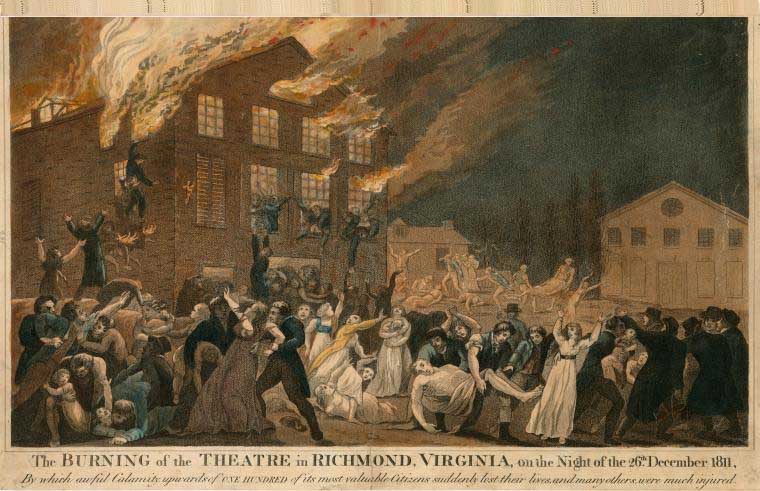
richmondtheatre

In Dr. Miller’s sermon, the first two major points of his sermon are much more in keeping with what we might expect. However, in his third division of the sermon—the moral applicationMiller uses the occasion to speak out against the theatre as an institution. In this, he echoed a common sentiment among Christians of his day, who generally opposed the theatre and the profession of acting.

For those with the time and interest to read, the text of Dr. Miller’s sermon follows.

A SERMON.

Lamentations 2:1,13: How hath the Lord covered the daughter of Zion with a cloud in his anger, and cast down from heaven unto the earth, the beauty of Israel, and remembered not his footstool in the day of his anger! What thing shall I take to witness for thee? What thing shall I liken to thee, O daughter of Jerusalem? What shall I equal to thee, that I may comfort thee, O virgin daughter of Zion? For thy breach is great like the sea; who can heal thee?

THE prophet Jeremiah lived in a dark and distressing day. Religion, among his countrymen, had sunk to an ebb awfully low. The body of the people had become extremely licentious in principle, and corrupt in practice. And a holy God had visited them with many tokens of his righteous displeasure. By fire, by famine, by pestilence, and by the sword, he had taught them terrible things in righteousness; until, at length, wearied with their iniquities, he delivered them into the hands of their enemies, by whom they were, as a people, nearly destroyed.

Over this melancholy scene of guilt and suffering the Prophet composed his Lamentations. And never were scenes of misery, and feelings of anguish, painted with a more masterly hand. Never were the pathos and tenderness, as well as the force of grief, more strongly displayed. As one of the ancient Fathers beautifully expresses it, “every letter appears to be written with a tear, and every word to be the sound of a broken heart; and the writer a man of sorrows, who scarcely ever breathed but in sighs, or spoke but in groans.”

Having been requested, on this occasion, to address my audience with reference to a late awful calamity, well known to you all, which had destroyed many valuable lives, and has covered a sister City with mourning; I have chosen the words just read as the foundation of what shall be offered. May the great Master of assemblies direct us to such an application of them as shall be profitable to every hearer!

How hath the Lord covered the daughter of Zion with a cloud in his anger, and cast down from heaven unto earth, the beauty of Israel! What shall I take to witness for thee? What thing shall I liken unto thee, O daughter of Jerusalem? What shall I equal to thee, that I may comfort thee, O daughter of Zion? For thy breach is great, like the sea; who can heal thee?

Without staying, at present, to explain in detail the several parts of this passage, I shall only observe, that by the daughter of Zion, and the daughter of Jerusalem, we are to understand, by a figure common with this Prophet, the inhabitants of the Jewish capital, in which Zion stood; or rather the Jewish nation, the covenanted people, the visible Church of God, under the Old Testament economy. Of course, what the Prophet applies to that afflicted city, may, without impropriety, be applied either to the whole, or any part of a community, who call themselves a Christian people; or who are embraced even by the most lax profession, within the pale of the visible Church.

We may therefore consider the text first, as a devout acknowledgment of the hand of God, in the afflictions which the Prophet laments;—secondly, as an expression of sympathy with the afflicted;—thirdly, as pointing to the moral application of the calamities which he deplored.

I. There is, in the passage before us, a devout acknowledgment of the hand of God, in the affliction which the prophet laments. How hath the LORD covered the daughter of Zion with a cloud in his anger! How hath the LORD cast down the beauty of Israel!

The doctrine, that the providence of God extends to all events, both in the natural and moral world; that nothing comes to pass without either his direct agency, or, at least, his wise permission and control; is a doctrine not only laid down in the plainest and most pointed manner in scripture; but also one which results from the perfections and the government of God when admitted in almost any sense. If there be a general providence, there must be a particular one. If God govern the world at all, he must order and direct everything, without exception. Yes, brethren, if it were possible for a sparrow to fall to the ground without our heavenly Father; or if it were possible for the hairs of any head to fail of being numbered by the infinite One; in short, if it were possible that there should be anything not under the immediate and the constant control of the Governor of the world; then it would follow that some things may take place contrary to his will; then prayer would be a useless, nay, an unmeaning service; then Jehovah would be liable, every moment, to be arrested or disappointed in the progress of his plans, by the caprice of accident. But, if none of these things can be supposed without blasphemy, then the providence of God is particular as well as universal. It extends to all creatures, and all their actions.—Is there evil in the city and the Lord hath not done it? No; the devouring fire; the overwhelming tempest; the resistless lightning; the raging pestilence; the wasting famine; and the bloody sword, even when wielded by the vilest of men, are all instruments in the hand of God for accomplishing his will and pleasure. And as the providence of God is actually concerned in every thing which befalls individuals or communities; so he requires us to notice and to acknowledge that providence in all his dispensations towards us. Not to regard the work of the Lord, or not to consider the operation of his hands, he pronounces to be sin; and denying his agency in the works of providence, he expressly condemns, as giving his glory to another.

While, therefore, we deplore the heart-rending calamity which had fallen upon a neighboring city, let us not forget, or place out of sight, the hand of God in the awful scene. It was not the work of chance. A righteous God has done it. His breath kindled the devouring flame. Not a spark of the raging element rose or fell without his providential guidance: not a victim sunk under its destroying power, without the discriminating and immediate hand of sovereign Wisdom. He ordered and controlled all the circumstances attending the melancholy scene. He doth not, indeed afflict willingly, nor grieve the children of men. But still affliction cometh not forth of the dust, neither doth trouble spring out of the ground. What! shall we receive good at the hand of God, and shall we not receive evil also? The Lord gave, and the Lord hath taken away; blessed be the name of the Lord!

II. The Language of the mourning Prophet, while it notices and acknowledges the hand of God in the calamities which it deplores, at the same time expresses the tenderest sympathy for the sufferers. This is indicated in every line of our text and context: and it is the feeling which ought to be cherished upon every similar occasion.

To sympathize with suffering humanity, however that suffering may have been produced, is a dictate of nature, as well as demanded by the authority of our common Creator. Thou shalt weep with them that weep, is a divine precept. When one member of the body suffers, all the members suffer with it. Thus it is in the social as well as in the physical body. Thus it is in domestic society. And thus it ought to be in the large family of a city, a state, or a nation. When one part of a nation is afflicted, all the rest ought to feel for it. When, therefore, any of our friends or neighbors, or any of the most remote portions of the same associated family are visited with any signal calamity, we are bound to consider it not only as a solemn lesson addressed to the whole body; but also as calling upon us to feel for, and sympathize with them; as they, under like circumstances, ought to sympathize with, and feel for us. When this is not the case, one great design of Jehovah’s judgments, which is to instruct and to impress a whole people, by the calamities of a part, is, undoubtedly, speaking after the manner of men, opposed and defeated.

The melancholy dispensation of providence which we this day deplore, is one pre-eminently calculated to interest the feelings, and to excite the tenderest sympathy of very mind. How shall we speak of a scene of such complicated horror? The heart sickens at the dreadful recital! When our beloved relatives die on the bed of disease, the event is solemn, and the bereavement trying; but it is the course of nature; and the frequency of the occurrence disarms it of more than half its terrors. When our friends and neighbors fall in battle, the stroke is painful; but the soldier is expected, by himself and by others, to be in danger of such an end. When those who sail on the mighty deep, are dashed on the rocks, or swallowed up in the merciless waves, we mourn over the catastrophe; but when be bade them farewell, we remembered that they might never return.

But how shall we describe a calamity which has plunged a whole city into agony and tears? A calamity which, to the number and the importance of its victims, added all the circumstances of horror which can well be conceived, to overwhelm the mind! How sudden the burst of destruction! How unexpected its approach, at such a place, and at such a time! What complicated agony, both to the sufferers and to the survivors, attended its fatal progress! But I dare not attempt further to depict a scene from which the mind revolts with shuddering!

Is there a Husband or a Wife who does not feel for those who saw beloved companions writhing in the merciless flames, and sinking in the most dreadful of all deaths, without being able to afford them relief? Is there a Parent who does not feel for those agonizing fathers and mothers, who saw their endeared and promising children torn from them in an hour of unsuspecting confidence and mirth? Is there a Brother or a Sister who does not sympathize with those almost frantic survivors, who were compelled to abandon to their cruel fate relatives dear to them as life? Is there a Patriot who does not feel for the fatal stroke which snatched an amiable and respectable Chief Magistrate from the bosom of a beloved family, and from the confidence of his fellow citizens? Is there a mind capable of admiring the attractive, the interesting, and the elegant, who is not ready to drop a tear over youth, beauty, genius, learning, and active worth, all sinking together in one smoking ruin? Is there a heart alive to the delights of society, and the endearments of friendship, who does not mourn over the melancholy chasm, which has been made in the social circles of that hapless city?—O Richmond! bereaved and mourning Richmond! What shall we say unto thee? How shall we comfort thee? Thy breach is great like the sea; who can heal thee? None but that God who has inflicted the stroke! O that our heads were waters, and our eyes fountains of tears, that we might weep over the slain of the daughter of thy people!

III. We may consider the passage before us as pointing to the moral application of the calamities which it deplores. Read the rest of this entry »

Tags: , , , , , , , ,

« Older entries § Newer entries »
