September 7: Vanguard Presbytery
Vanguard Presbyterian was organized this day, September 7, 1972. As John Edward Richards wrote, “There were ministers and churches who could not wait for the formation of the new church. Under…

Daily devotional readings in Scripture, the Westminster Standards, & Presbyterian history.
A Christian Statesman
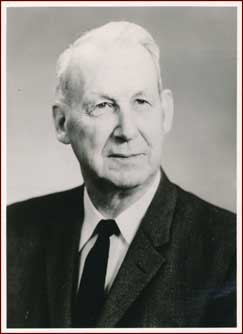
Charles Darby Fulton was like many other conservative Presbyterians who chose to stay with the mother church rather than leave to join the newly formed denomination as it took a stand against modernism and apostasy. Their reasons for staying may have been varied, but conservatives like Fulton in many respects stayed for the tougher fight, for their numbers were even fewer after the exodus.
There is however something unique about the Rev. C. Darby Fulton that makes you want to know more about the man. He was widely typified as a Christian statesman. One way in which he demonstrated that quality of character was in the fact that, while he did not choose to come into the Presbyterian Church in America at its formation in 1973, he nonetheless was quite willing to bring a message during the PCA’s first General Assembly. Some conservatives who chose not to come into the PCA ignored or even opposed the new denomination. Darby Fulton was different, and that difference is part of what marks him out as a true Christian statesman. It’s part of what makes you want to know more about the true character of the man.
Charles Darby Fulton was born on September 5, 1892, in Kobe, Japan. His parents, the Rev. Samuel Peter Fulton [1865-1938] and Rachel Hoge Peck Fulton, were missionaries sent out by the Southern Presbyterian Church.
Darby Fulton was educated at the Presbyterian College of South Carolina, graduating there with the B.A. degree in 1911, and then earning an M.A. from the University of South Carolina in 1914 [note his thesis topic, in the blbiiography below] before turning his attention to preparation for the ministry at Columbia Theological Seminary. Graduating from Columbia in 1915, he lastly attended Princeton Theological Seminary, and there earned the STB degree n 1916.
Rev. Fulton was ordained on June 25, 1915 by the Presbytery of Enoree [PCUS]. During the time that he was attending Princeton, he transferred his ministerial credentials to the PCUSA, and supported himself by serving the Glassboro and Bunker Hill churches, 1916-1917. Then upon graduation from Princeton, he was received back into Enoree Presbytery and the PCUS as he answered a call to missions work. It was at about this time that Rev. Fulton married Nannie Paul Ravenel, of Spartanburg, South Carolina, in October of 1917.
Departing for the PCUS operated Japan Mission, the Fultons served there from 1918 until 1925. Thereafter Rev. Fulton served as Field Secretary, 1925-32, and then as Executive Secretary, 1932-61, for the PCUS Board of Foreign Missions.
Dr. Fulton served as a professor at his alma mater, Columbia Theological Seminary, from 1962 to 1965, and on September 1, 1965, was entered on the rolls of Presbytery as honorably retired. During his lifetime, he had received a number of honors, including having served as the Moderator of General Assembly [PCUS] in 1948. The Presbyterian College of South Carolina awarded him the Doctor of Divinity degree in 1924 and he received the LL.D. degree from King College in 1952. Following his retirement, the Rev. Dr. C. Darby Fulton lived another twelve years, and he died on May 27, 1977, at the age of 84, while residing in Nashville, Tennessee. Prior to his death, he had established a fund to assist the Kobe Theological Seminary in Japan.
Partial Bibliography:
1914 – Financial Condition and Its Relation to Character. M.A. thesis at the University of South Carolina.
1938 – Star in the East
1946 – Now is the Time
1949 – Report on China.
1959 – Lectures: Series of three lectures delivered before the Synod of Virginia at Massanetta Springs, June 29-30, 1959.
1959 – Missions: Our philosophy, our program, contemporary problems (1959)
1966 – “Baptism in Reformation Perspective,” in One Race, One Gospel, One Task: World Congress on Evangelism (1966)
1973 – “The Excellency of the Knowledge of Christ,” in Addresses delivered during the First General Assembly of the National Presbyterian Church. Montgomery, AL: The Office of Administration, 1973. pp. 32-34.
Undated – “The Gospel is Relevant. Weaverville, NC: The Presbyterian Journal, n.d. Tract, 12 p.
Words to Live By:
For this section today, we would like to provide here the text of Rev. Fulton’s address on the occasion of the First General Assembly of the Presbyterian Church in America:
The Excellency of the Knowledge of Christ, by C. Darby Fulton [Text: Philippians 3:7-14]
Every life has a key word. With some it is money; with others, pleasure; with still others, fame. With Alexander the Great it was conquest; with Napoleon, France; with Edison, science; with Paul, it was Christ.
Paul interpreted every phase of his life in its relation to Christ. When he rejoiced, it was in Christ; he gloried in Christ; he conquered in Christ; he was strong in Christ; and he took pleasure in weaknesses, in injuries, in necessities, in persecutions and distresses for Christ’s sake. For him, to live was Christ.
Dr. J. Gresham Machen’s address on “The Necessity of the Christian School,” is permanently posted here. but it remains so timely, I’ve posted the whole of it here today.
The Necessity of the Christian School
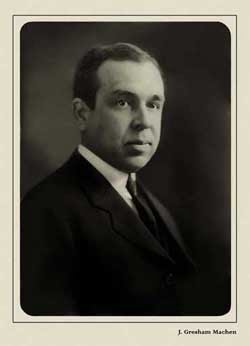 by Dr. J. Gresham Machen, Professor of New Testament in Westminster Theological Seminary, Philadelphia, Pa.. This is a reprint of a lecture given by Dr. Machen at the Educational Convention held in Chicago under the auspices of the National Union of Christian Schools, August, 1933.
|
Two Reasons for the Christian School
|
The Christian school is to be favored for two reasons. In the first place, it is important for American liberty; in the second place, it is important for the propagation of the Christian religion. These two reasons are not equally important; indeed, the latter includes the former as it includes every other legitimate human interest. But I want to speak of these two reasons in turn.
In the first place, then, the Christian school is important for the maintenance of American liberty.
We are witnessing in our day a world-wide attack upon the fundamental principles of civil and religious freedom. In some countries, such as Italy, the attack has been blatant and unashamed; Mussolini despises democracy and does not mind saying so. A similar despotism now prevails in Germany; and in Russia freedom is being crushed out by what is perhaps the most complete and systematic tyranny that the world has every seen.
But exactly the same tendency that is manifested in extreme form in those countries, is also being manifested, more slowly but none the less surely, in America. It has been given an enormous impetus first by the war and now by the economic depression; but aside form these external stimuli it has its roots in a fundamental deterioration of the American people. Gradually the people has come to value principle less and creature comfort more; increasingly it has come to prefer prosperity to freedom; and even in the field of prosperity it cannot be said that the effect is satisfactory.
The result of this decadence in the American people is seen in the rapid growth of a centralized bureaucracy which is the thing against which the Constitution of the United States was most clearly intended to guard.
|
The Attack Upon Liberty
|
In the presence of this apparent collapse of free democracy, any descendant of the liberty-loving races of mankind may well stand dismayed; and to those liberty-loving races no doubt most of my hearers tonight belong. I am of the Anglo-Saxon race; many of you belong to a race whose part in the history of human freedom is if anything still more glorious; and as we all contemplate the struggle of our fathers in the winning of that freedom which their descendants seem now to be so willing to give up, we are impressed anew with the fact that it is far easier to destroy than to create. It took many centuries of struggle — much blood and many tears — to establish the fundamental principles of our civil and religious liberty; but one made generation is sufficient to throw them all away.
It is true, the attack upon liberty is nothing new. Always there have been tyrants in the world; almost always tyranny has begun by being superficially beneficent, and always it has ended by being both superficially and radically cruel.
But while tyranny itself is nothing new, the technique of tyranny has been enormously improved in our day; the tyranny of the scientific expert is the most crushing tyranny of all. That tyranny is being exercised most effectively in the field of education. A monopolistic system of education controlled by the State is far more efficient in crushing our liberty than the cruder weapons of fire and sword. Against this monopoly of education by the State the Christian school brings a salutary protest; it contends for the right of parents to bring up their children in accordance with the dictates of their conscience and not in the manner prescribed by the State.
That right has been attacked in America in recent years in the most blatant possible ways. In Oregon, a law was actually passed some years ago requiring all children to attend the public schools — thus taking the children from the control of their parents and placing them under the despotic control of whatever superintendent of education might happen to be in office in the district in which they resided. In Nebraska, a law was passed forbidding the study of languages other than English, even in private schools, until the child was too old to learn them well. That was really a law making literary education a crime. In New York, one of the abominable Lusk Laws placed even private tutors under state supervision and control.

